resources designed to help you tap into your unique voice and take comedy beyond the stage.
NEW!
NEW!
Introducing… The TLC Guide Series!
Comprehensive, actionable guides for comedians at every stage. Each 25-35 page guide offers expert education, reflection prompts, and practical exercises to support both your craft and your personal growth!


A comedian’s introduction to bombing, rejection, imposter syndrome & self-doubt and how to recover every time.


TLC’s Stand Up Glossary
This is for you to look up words and lingo that may come up along your journey. There wasn’t a glossary when I started, so I hope this quells some of the nerves of “what were they talking about?!” — now you will know! If you come across a term that isn’t listed below, please email thelaughthercollective@gmail.com. Please share!!!
Absurd: Also referred to as surreal comedy, and tends to bend reality and juxtapose common reasoning. This kind of comedy asks the audience to suspend the rules of logic at times.
Notable comedians include Andy Kaufman, Maria Bamford, Eric Andre, Jenny Slate, & Julio Torres.
Absurd comedy allows audiences to escape from the constraints of reality and immerse themselves in a world of ludicrous scenarios and nonsensical humor. Absurdism provides an important role in comedy by continuing to encourage creativity and innovation within the field.
If you’re a comedian wanting to explore the world of absurd comedy a great way to begin would be by studying the aforementioned comics and analyzing their unconventional comedic techniques. In absurd comedy, commitment to the absurdity of the premise is key.
Act Out: Taking on a character’s point of view and behaving as if you were them during a stand-up routine. For example: “My boss is so selfish! Last week he goes, (gruff voice) “I’m gonna need you to come in on the weekend so I can go play golf and eat hamburgers.” Showing, not just telling.
Act outs are a fantastic way for comedians to visualize their humor, add variety and highlight characters and situations. Mastering the art of act outs can significantly elevate a comedian’s performance.
You can hone your act out by first identifying what your strengths are as a performer! Can you do a killer Irish accent? Do you crack your friends up when you do your Elaine-like dance on the dance floor? Incorporate these natural strengths into your sets.
Comedian/Actor Jim Carrey excels at Act Outs and developed his skills by mimicking his favorite over-the-top performers in the mirror. His stand up comedy special ‘Unnatural Act’ is a masterclass in the art of act outs.
Agent: A person who capitalizes off of your talent by providing you with regular opportunities. A manager can only take XX%.
“Alt” Comedy: A term used to describe stand up that intentionally differs from the mainstream comedic style of that era. For example: a bar show in Bushwick with comedians doing experimental comedy would be more “alt” than most acts who headline a popular club like The Comedy Cellar in New York City.
The OG Alt Venue: The Comedy Strip,
Well known alt-comics: Janeane Garafalo, Sarah Silverman, Reggie Watts, Eugine Mirman
Alt comedy is important because it challenges comedians to think outside the box and creates a space for risk-taking.
Alt comedy provides a platform for comedians from diverse backgrounds, perspectives and experiences.
A-Material: Also known as “A-Jokes” this is a stand-up set that contains what the comic considers to be their best and funniest jokes. Typically, this is what is presented in Netflix specials, Comedy Central Presents, and other large-scale performances. Some comedians go as far as to label their material either A B or C with the intention of tightening C jokes until they reach A status; which is their highest quality of material.
Although having an alphabet ranking is entirely optional, the practice of identifying your strongest material is very important for a stand up comedian. This aids in how they will structure a set and will determine their choices of material for showcase opportunities.
Here’s an example of an "A-joke" comedian Mitch Hedberg: "I used to do drugs. I still do, but I used to, too."
This joke is concise, clever, and embodies Hedberg's unique style of deadpan delivery and absurd humor. It's a joke that has been widely appreciated and is often cited as one of his best.
Assets: A show’s logistical information including name, description, who’s performing alongside a headshot and bio, ticket cost, and all other need-to-know information about your show.
Authenticity: Authenticity refers to the quality of being genuine, real and true to yourself. It involves sincerity, honesty and integrity. For many artists, authenticity involves expressing your true thoughts and feelings, rather than conforming to society norms.
Hannah Gadsby’s authenticity in addressing issues like gender, sexuality, and trauma in her Netflix special, ‘Nanette’ resonated with audiences worldwide.
Aparna Nancherla's comedy often revolves around her experiences as an Indian American woman dealing with anxiety and navigating societal expectations, which is deeply authentic.
Authenticity starts with self-awareness. For comedians wanting to become more authentic, an excellent way to start is by understanding their own experiences, beliefs and unique perspectives or point of view.
“Barking”: "Barking" for a comedy show refers to the practice of comedians or individuals associated with the venue actively promoting the show by inviting passersby to attend. This often involves standing outside the venue or in nearby areas, engaging with people, and encouraging them to come enjoy the show.
Barking is a promotional strategy especially for smaller or independently-run venues where word-of-mouth and grassroots marketing can significantly impact attendance. It helps increase visibility for the show, attract new audience members, and create a lively atmosphere around the venue.
If you visit Times Square in NYC, you will undoubtedly see people “barking” for stand up comedian shows in the area!
Similar to Bringer Shows, this is often pushed upon beginner comedians as a way for the club to make money.
Beat: An intentional pause taken during material for emphasis, utilizing tension.
Used in a sentence: "After delivering the punchline, the comedian paused for a beat, allowing the audience to process the joke before erupting into laughter."
The word beat originated from the world of theater, specifically techniques of timing and rhythm used by actors. By emphasizing beats, actors are able to convey nuances of their characters and story.
Fun Fact: In drag culture, a "beat" refers to the application of makeup, particularly the elaborate and transformative makeup worn by drag queens and performers.
Bit: A series of jokes on a single topic. Can include just one, or several punchlines, although traditionally just one premise. Used in a sentence: “I’m going to do my bit on the moon landing tonight, then finish off with that water-skiing bit.”
Check out this Paula Dean bit from Maria Bamford.
Vulture wrote this great article about the bits all around us and starting at a young age.
Blue material: “Edgy” jokes that involve sexual topics, swearing, and/or graphic content.
Joan Rivers gave us many raunchy blue jokes in her impressive 55-year career. Here’s a great list of some of her raunchiest!
Comedians should approach this style of comedy with caution because it can easily offend or alienate audiences if done inappropriately. It’s important to first understand your audience, use discretion and know your own boundaries.
Cracked provides a great list of who they believe to be the dirtiest comedians of all time, including our favorite #14 Moms Mabley.
Bomb: A comedy performance which generates little to no laughter. Discussed as though it’s the end of a career, but truly it’s a right of passage for every single comedian you know. Bad nights are inevitable in every profession – this is what a bad night is called for comics.
https://www.liveabout.com/bombing-in-comedy-definition-801512
Experiencing “bombing” on stage is actually a very valuable learning experience for comics. It can teach them resilience, humility, adaptability and even innovation. Although uncomfortable and discouraging in the moment, it helps comedians learn and grow to become better in the long run.
The Upright Citizens Brigade has a great book about the best tips, bits and bombs in the biz!
Booker: A person whose sole responsibility is to book performers for a particular venue.
Bringer Shows: A type of comedy show where the venue requires you to bring a certain number of audience members, often friends or family, in order to perform.
By requiring comedians to bring their own audience, the venue can increase ticket sales and generate revenue. We do not suggest doing bringer shows, as it pressures comedians to prioritize ticket sales over talent.
Despite criticism, bringer shows remain a common feature in the comedy scene and there are comedians who view them as a valuable stepping stone.
Callback: A joke which references a joke that occurred earlier in a set. Often elicits a strong laughter response and brings a sense of closure to a set.
Callbacks are important because they satisfy the audience, especially when calling back at the end of a set to a joke from earlier in the set. A callback can make the audience feel “in” on the joke and helps to establish trust.
Practice the art of callbacks by simply including them more in your stand up comedy set. Pull a tag line from a strong opener, and opt to transform it into a clever callback at the end of your set.
Here’s an example of a callback from Bo Burnham. Initial joke: "I'm not religious, but I do think that we should, you know, let it play out with the Second Coming. I mean, maybe Jesus will return and be like, 'You got it all wrong! I would never have said those things.' Or he would come back and be like, 'Nailed it!'"
Callback: "And he says, 'Let he who is without sin cast the first stone.' And I'm like, 'What about me?'"
In this example, Bo Burnham references the idea of the Second Coming of Jesus and the phrase "let he who is without sin cast the first stone." Later in his routine, Bo callbacks to the previous joke by questioning his own sinfulness, creating a humorous connection between the two segments of his set.
Catchphrase: A sentence or phrase repeated by the performer which becomes a joke in and of itself. These phrases might be funny lines, witty remarks, or exaggerated expressions that the comedian uses to punctuate their jokes or engage with the audience.
Catchphrases are important because they can help comedians build rapport with their audience and create a sense of familiarity and recognition.
An example of a catchphrase from comedian Jerry Seinfeld is, “What’s the deal with _____.” Rodney Dangerfield famously coined, “I don’t get no respect!” as his catchphrase.
Having a catch phrase is a dated stand up comedy troupe, but the exercise of exploring what your catch phrase would be could help further explore your comedic persona.
Character: A persona of another that is performed using key and identifying characteristics.
Characters in comedy provide audiences with relatable figures they can identify with. Whether they're exaggerated versions of real people or entirely fictional, characters help ground the comedy in a recognizable context, making it easier for audiences to connect with the humor.
Eddie Murphy is known for his memorable character portrayals, including Buckwheat from Saturday Night Live and Mister Robinson, a parody of Mr. Rogers. Tracey Ullman inhabited a wide range of characters from housewives to eccentric celebrities in her sketch comedy show, “The Tracey Ullman Show.”
If you want to explore doing characters in your stand up comedy routine, we suggest observing real people and studying different personalities, mannerisms, speech patterns, and quirks. Drawing inspiration from real-life can help you create authentic and relatable characters. Additionally, researching specific demographics, cultures, or professions relevant to the character can add depth and authenticity to their portrayal. Then it’s all about playing with different physical and vocal attributes to find what works best for each character.
Clapter: When a joke elicits not just laughter, but an applause to signify an additional level of agreement or support. This typically happens when something extraordinary is done or a point is summated beautifully.
This article in Vulture explores the rise of ‘Clapter Comedy’ which actually originated within the comedy community.
Closer: The last joke a comic tells as part of their set. Often contains a callback, but not always. In almost all cases, the closer should be one of the funnier bits of the set.
In stand up comedy it is very important that your closer is one of your strongest jokes. You want to bookend your set with your best material and make sure to leave a lasting impression on your audience.
Here’s a closing joke aka a closer from comedian Ali Wong in her Netflix Special, ‘Baby Cobra.’ : "And the last thing I will leave you guys with, is, you know, in life, there's only two things. There's only two things you can control, okay? There's only two things you can control: your actions and your attitudes. Okay? That's it. You can't control what anybody else thinks of you. You can't control what anybody else does. But you can always control how you react to it. That's all you need to know. You just gotta stay consistent. You gotta stay consistent and just be like a cockroach. That's what you gotta do. Just stay consistent and be like a cockroach. I'm half Chinese and half Vietnamese, and those are the two hardest-working immigrant groups, okay? So I'm a hard worker. I'm consistent. And I'm like a cockroach. I never give up. Goodnight!"
Comedian: Also referred to as a “comic”, is a person who intends to bring laughter to an audience. Used to describe what people are like and as a profession or side hustle. Comedy can be traced back all the same to Sumerian tablets in 3000 B.C.
Comedic Timing: The precise delivery of a joke, paying close attention to tone, pace, audience’s reaction and using tension, pausing, and tags to heighten further.
Having comedic timing is crucial for stand up comedians. Timing enhances your delivery by building and releasing tension and ultimately maximizing the impact of a joke. Timing is the difference between an ordinary joke and a truly hilarious moment.
Ellen Degeneres’s stand up comedy serves as a fantastic example of timing. She has a knack for pausing at just the right moment before delivering a punch line, allowing the audience to fully appreciate the humor.
A comedian wanting to practice timing can record themselves workshopping material and review/study the footage closely. Small changes such as tightening or lengthening pauses, adjusting delivery speed and refining punchline delivery can make a huge different when it comes to comedic timing.
At TLC, students record their workshops and feedback from class to optimize improvement within a safe and encouraging setting.
Comedy: A profession, genre, or style that is intending to make others laugh.
Comedy has its roots in ancient civilizations like Greece and Rome. In Greece, comedy was an integral part of festivals like the Dionysia, where comedic plays called "comedies" were performed alongside tragedies. These comedies often satirized social and political issues, mocked stereotypes, and celebrated the absurdities of human behavior, much like they still do today!
Comedy is now a diverse genre with many subgenres and styles including:
Stand Up Sketch Improv Sitcom/Situational Slapstick Dark
Comedy can serve various purposes, including providing escapism, offering social commentary, challenging societal norms, or simply bringing joy and laughter to audiences. It is a universal form of entertainment that transcends cultural and linguistic barriers, connecting people through shared laughter and enjoyment.
Comedy Club: An establishment where comedy is performed. Similar to a night club in that the space is dark, alcohol is typically available & sometimes required for purchase by the audience. A bit dated in that the venue may not be a club, per se, but for the start of comedy there are well-known beacons across America.
Comedy Cellar, Greenwich Village Comedy Club, & formerly Caroline’s – NYC
Comedy Store, Hollywood Improv – LA
Zanies & Second City (improv) – Chicago
The Punchline, Laughing Skull Lounge – Atlanta
Cap City Comedy Club – Austin
Columbus Funny Bone – Columbus
Comedy Work – Denver
Improv Houston – Houston
Crackers Comedy Club – Indianapolis
Miami Improv ComedyClub – Miami
Acme Comedy Company – Minneapolis
Helium Comedy Club – Philadelphia & Portland (more venues all over)
Rick Bronson’s House of Comedy - Phoenix
Bricktown Comedy Club, Loony Bin Comedy Club – Tulsa
When performing at a comedy club, the goal is typically to ‘get passed’, which means you are received the club’s blessing and are given the chance to perfect your material on their stage during the late night hours.
Comic Relief: The use of comedy to offset a tense moment or topic. Comic relief is often used by Hannah Gadsby, John Oliver, and others when discussing difficult or traumatic topics.
Comic relief plays an essential role not just in stand up but in every day life! Laughter has been shown to have numerous health benefits including reducing stress, boosting mood and improving overall well-being.
The technique of comic relief is especially popular in regards to social commentary. Oftentimes, comedians are able to address serious issues in a more palatable and accessible way, providing much needed comedic relief.
Crowdwork: Interacting with the audience at a stand up show. Seemingly spontaneous, there is usually a technique and preparation involved.
In a category all in her own, Jessica Kirson is a joy to watch during this CW special
Nicole Byer has a sensational special of just crowdwork.
TLC teaches a “to & through” concept to explain crowd work as a technique.
Dark: A genre of comedy focused on making light of taboo or controversial topics.
George Carlin is known for his sharp wit and social commentary and often delved into dark topics such as religion, politics, and mortality.
Stand Up comedians are deemed “dark” when they challenge audiences with their material and use comedy as a way to explore uncomfortable truths. Oftentimes dark comedians push the boundaries of what is considered acceptable or appropriate.
TLC has a course called “Laughing Through Loss” that tackles how you can approach trauma-related premises.
Deadpan: A delivery or persona choice that lacks expression entirely.
Aubrey Plaza is famous for the deadpan delivery she has brought to ‘Parks and Recreaction.’
Tig Notaro is known for her calm and deadpan demeanor on stage, delivering jokes in a matter-of-fact manner.
Deadpan delivery is considered humorous because it plays on your expectations and often catches audiences off guard. It relies on subtlety and understatement for its effectiveness.
Door Deal: The agreement between the person putting on the show (producer) and the venue. These deals are negotiable, and can include drink minimums to # of tickets sold. Not every venue
Double Entendre: A word or phrase that has two meanings or interpretations. Homophones are often involved, and the 2nd meaning is typically of a sexual nature. For example, Mort Walker’s quote: “Seven days without laughter makes one weak.” – weak is both the way someone will feel and seven days is a WEEK. *mind blown*:
There’s even a Master Class on the double entendre!
Sometimes confused with Puns, a Double Entendre is a popular type of wordplay.
Here’s a great list that breaks down many different types of wordplay popular in writing!
Edinburgh Fringe Festival: Sometimes referred to as just Edinburgh or The Fringe, this is one of the largest global festivals to showcase shows. The Edinburgh Festival Fringe is one of the greatest celebrations of arts and culture on the planet and takes place every August in Edinburgh, Scotland’s capital city.
Offering over 3,000 productions at more than 300 venues, the festival has launched smash hit international shows like SIX: The Musical and played a part in building the careers of many actors since it began in 1947.
Here’s a list of just some of the famous names who made their start at Fringe!
Elevator Pitch: A short delivery, about 45 seconds, sharing who you are, what makes you stand out, and what you want clearly and concisely.
This Balance article gives clear direction for coming up with one.
An elevator pitch is a powerful tool for personal and professional communication, enabling you to succinctly convey your message, capture attention, and create opportunities in various situations.
This article from Princeton breaks down not only what an elevator pitch is, but why you need one!
Escapism: Escapism is the tendency or desire to seek distraction and relief from the pressures and demands of everyday life, often through activities that provide a temporary mental or emotional escape.
It involves seeking solace or entertainment in activities that transport individuals to alternative realities or experiences, allowing them to temporarily detach from their surroundings or problems.
Farce: A genre of comedy that takes a nonsensical, absurd, ridiculous perspective on a given topic. Exaggerated and improbable are the essence of farce.
Producer and infamous storyteller, Mel Brooks, has shared a number of farce movies, like The Producers, which is a perfect example.
Feature: Not a regular on a show, but a person or act that is being showcased as a guest spot.
Festival: A series of shows and events in a particular area to showcase alot of talent. Often times requiring a submission tape to show what a comedian is capable of, festivals range in length of time, duration of shows, and cost.
Freewrite: A written stream of consciousness to compile all of your thoughts, references, & feelings with no attention to spelling, grammar, punctuation or judgment of any kind. This is the third part in TLC’s Writing Process, following a list made from a prompt. It is from your freewrite where Golden Nuggets are excavated from. (See Golden Nuggets)
*Can be down verbally using recording devices as well.
Here is an app/website for those that require more formality with something very informal. This has a timer,
Genre: A style or particular category.
Used in a sentence:
Gig: A stand-up comedy performance. Usually the word gig implies a paid performance.
Used in a sentence:
Green Comedy: In short, toilet humor. Typically jokes about excretions, lewdness, and topics alike.
Golden Nugget*: A joke opportunity, typically found in a free write. It stands out, there’s never just one, and comes in all different shapes & sizes.
Hack: A premise, topic, or joke that is well-explored and contains very few surprises. It is not desirable to be considered a “hack.”
Being considered a "hack" in the world of comedy is like being labeled the last slice of bread in a bag—you're stale, predictable, and nobody wants you. ←Hey! Look at us writing a Rule of Three style Joke!
Headliner: The final performer of a paid show, typically with at least one opener, or warm up comic. They are the highest paid, and often the most seasoned or popular of the performers. This is the act that the people came for.
Headliners typically perform for at least 45 minutes, and sometimes longer.
Headliners sometimes bring their openers with them; OFTEN TIMES, they are just as interested in local talent so don’t be discouraged to shoot a shot. #EcoFriendly
Heckler: Any audience member who interrupts a comic’s routine. It is important to note that many hecklers mean well, and actually think they are “helping” make the show better. Because of the illusion of spontaneity that stand-up comedy generates, this misunderstanding about the importance of allowing a comic to perform uninterrupted causes a lot of conflict. It is important to remain in control.
Check out our 3 strike policy when Handling Hecklers here!
Ariel Elias faced one of the worst types of hecklers, and truly embodies remaining in control.
Heightening: The act of material building to a climax. Additionally, heightening can be used to describe how to take a joke to another level by raising the stakes and “doubling down”.
Host: The person responsible for opening and closing the comedy show, as well as introducing comics, making announcements and maintaining order in the room. Also referred to as the M.C.
The host plays a pivotal role in shaping the overall experience of a comedy show, from establishing the initial atmosphere to maintaining momentum and ensuring that both performers and audience members are having a great time.
To become a skilled host it is helpful to study other hosts, build confidence in your material and ability to adapt, practice maintaining a high level of energy, feel comfortable actively engaging with your audience, and seek feedback for continuous improvement.
One example of a famous comedy host is Steve Harvey, known for his hosting roles on shows like "Family Feud" and "The Steve Harvey Show." Late Night Television Programs and Variety shows have hosts as well as any show at your local comedy club.
TLC teaches a Hosting & Crowdwork Workshop in NYC, if you’re around.
Humor: A quality of eliciting laughter, lightening the mood. The ability for someone to recognize comedy or a joke is a person’s sense of humor.
Humor is symbolized as a smiling face mask, sometimes coupled with a sad one.
Someone can hone their authentic sense of humor by paying attention to what genuinely amuses them, experimenting with different comedic styles and delivery techniques, and practicing regularly in both casual and performance settings.
Improv: Thinking on your feet in the moment and using what you have, with nothing prepared. Typically seen during crowdwork.
Improvisational comedy, or improv, has roots in early theater forms like Commedia dell'arte. It gained popularity in the mid-20th century with influential groups like The Compass Players, The Second City and Upright Citizens Brigade eventually leading to the widespread recognition of improv as a comedic art form through television shows like "Whose Line Is It Anyway?"
Former SNL cast member and current stand up comedian / actress Sasheer Zamata is a skilled improviser. For years, she had an improv troupe at UCB NYC with comedians Nicole Byer and Keisha Zollar called ‘Doppleganger.’
Industry: Another term for the entertainment business. Industry encompasses a wide range of individuals and entities, such as comedians, agents, managers, producers, writers, directors, comedy clubs, television networks, streaming platforms, film studios, comedy festivals, and more. The "industry" plays a significant role in shaping the landscape of comedy, influencing trends, careers, and opportunities within the field.
Insult Comedy: A style of comedy where a comedian ridicules and insults others in an exaggerated and humorous manner. It is a tightrope to walk.
Well-known originators of this form include Don Rickles, Rodney Dangerfield, Lenny Bruce & Joan Rivers.
Key & Peele have a great sketch about the Insult Comedian
Joke: Something said intending to cause laughter. There are many different kinds of jokes including puns and one liners. However most jokes consist of at least two parts: a set up and a punch line.
All jokes are either a short-form or long-form joke. A short form joke is summed up in a sentence or two. Monologue Jokes are a great example of short form jokes. A long form joke is more like a paragraph, with a setups and punchlines peppered throughout the premise.
Jokes can also include a tag line!
The set up of a joke contains your premise.
Just For Laughs, JFL: One of the largest festivals for stand up comedians hosted in Montreal every year until 2024. Considered a major milestone in a comedian’s journey.
Kill: A comedy performance that generates an extremely enthusiastic response from the audience.
Used in a sentence: “Taylor Tomlinson killed last week in Houston – the crowd never stopped laughing!”
‘We Killed! The Rise of Women in American Comedy’ is a fantastic book about “killing” and that clearly outlines the barriers and challenges that women have faced in comedy (as well as how far we still have to go).
Laughter: Pleasant sounds and facial expressions of enjoyment coming from a being.
Laughs Per Minute (LPM): A system to measure the success of a stand-up comedy performance by paying attention to the number of laughs you’re getting in a given minute with the goal being to achieve the highest number of laugh lines possible. This system is not for everyone and doesn’t speak to the quality the work.
Phyllis Diller holds the world record for most LPM with 12 LPMs.! (At 3:18, you’ll experience clapter!)
[the] “Light”: Every time a comic performs a set they will get a “light” at a club that informs them of how much time they have left. This is usually a red light bulb coming from the tech booth or overhead. For short sets you usually get the light when you have 1 or 2 minutes left in your set. For a headliner, they may request the light when they have 10 minutes left of their hour set. Also, for smaller rooms or bars producers may give you the light by flashing their cell phone. (This will be what we do at our grad show).
Line-up: A group of two or more comics who will be performing in a show. The line-up will be posted or shared ahead of time for a gig, but may not be available until the night of for mics. If a time or number is listed next to the comedian, that is the expected length of their set.
Manager: A person that coaches and aids you in developing as a professional – a manager’s role is a bit loose in that sense.
M.C: Stands for Master of Ceremonies, essentially the host of a show. This role is also known as the “emcee.” They have many important jobs including: hosting the event, introducing performers, performing a warm-up act, managing transitions between acts, engaging with the audience through crowd work, keeping track of time, and handling any unforeseen situations that may arise during the show. They play a pivotal role in ensuring the smooth running of the event and keeping the audience entertained and engaged.
Comedians are often asked to M.C. high profile award shows. This impressive list of every Oscar host in history is sure to feature some of your favorite comics!
The Interrobang, a super comedy news source, has an article on the ‘5 Unbreakable Commandments of Hosting a Comedy Show,’ as shared by popular M.C. James Mattern.
Mix: A comparison joke that connects two elements that people don’t associate with one another. The ‘surprise’ element of the comparison causes laughter. Mixes usually contain similes or metaphors.
“Dating is like pushing your tray along in a cafeteria, nothing looks good but you know you have to pick something by the time you reach the cashier.” - Caprice Crane
Misdirect: Misdirection in writing is a method of strategically drawing a reader's attention from certain clues that are otherwise in plain sight. More specifically, in stand up comedy a misdirect is a kind of joke where you lead the audience to believe one thing and then you surprise them by revealing something unexpected.
“Once I was with two men in one night. But I could never do it again—I could hardly walk afterward. Two dinners? That's a lot of food.”- Sarah Silverman
Misdirects are one of the most popular kinds of jokes in stand up comedy. They are important because they create surprise, which is a key element of humor.
If you’re a comedian looking to hone the art of writing misdirects, it’s helpful to play with tension.
Moderator: In a greater sense, a moderator is someone who facilitates a discussion or debate by guiding the conversation, ensuring all participants have an opportunity to speak, and maintaining order. For comedy purposes specifically, the moderator focuses on guiding comedic conversations, ensuring that the dialog remains lively and humorous!
A moderator may also pose questions, moderate audience participation, and intervene all with the aim of facilitating a smooth and engaging discussion!
Comedian Sarah Silverman has moderated panels and discussions on various comedy-related topics at events like South by Southwest (SXSW) Comedy Festival.
Monologue Joke: Monologue Jokes are a kind of short form, punchy and topical joke delivered by a comedian or host during the monologue segment of a late night television show. Monologue jokes consist of just one or two sentences and typically use a delivery style with an emphasis on timing and rhythm. Monologue Jokes are a staple for late-night-tv shows but comedians often use monologue-style-jokes in their sets.
This article from the AV Club that breaks down Monologue Joke Writing in an easy-to-understand way
Here is a great list of some of the funniest monologue jokes from Late Night Television
Email TLC for a super helpful list of Monologue Joke transitions, commonly passed around the writer’s room. This was shared by Emmy-nominated and WGA Award-Winning Late Night Writer Laurie Kilmartin.
Musical: A genre of comedy that incorporates musicality and songwriting.
Perhaps the most popular is Weird Al Yankovic, who is known for his musical parodies.
More recently, Garfunkel & Oates are creating some great songs. Marcia Belsky’s 100 Tampons went viral for good reason.
Adam Sandler’s The Chanukah Song is another classic example.
Networking: The act of getting to know other people in a particular field or room in hopes of finding connections. Networking can bring about mentors, people who provide guidance & support, and sponsors, people who vouch for you so you both look better. Often time, comedians network at shows and open mics to find out about festivals, opportunities, and inside-information.
Observational (Comedy): Observational comedy is derived from everyday life experiences. Comedians make observations on human behaviors, society at large and highlight the humor found in the ordinary aspects of life. Comedians who use observational humor find the funny in the mundane and are able to connect with and relate to any audience.
To watch this in action, check out: Taylor Tomlinson, Ellen Degeneres, Michelle Buteau. Wanda Sykes, Iliza Shlesinger, and Kathleen Madigan
One-liner: A short-form joke in which the premise and punchline are delivered within a single sentence. These are quick setups and punches.
Steven Wright, known for his deadpan delivery and surreal humor, is a master of the one-liner. His jokes are often absurd and thought-provoking, with lines like, "I intend to live forever. So far, so good."
Dad jokes & children’s jokes are excellent, albeit corny, examples of these.
Getting good at writing one liners, like any other form of writing, requires practice, creativity and a keen understanding of comedic timing and delivery.
Wordplay is an especially powerful tool in writing one-liners. Experiment with puns, double entendres and other forms of linguistic humor to create clever and unexpected punchlines.
Open Mic: Short for “open microphone” an open mic is an opportunity where anyone, regardless of skill or experience, can practice performing on stage. Open mics offer an informal environment, stage experience and the opportunity to test out new material.
Open mics range from two minutes to seven minutes. Some are free, and some cost money → none of this is indicative
Opener: An opener is the first comedian or performer to take the stage. An opener can also be called a ‘feature’ , an ‘opening act’ or the ‘opening comic.’ Their job is to engage the audience, grab their attention, and get them ready for an evening of laughter. A strong opener can effectively energize the crowd and create a positive atmosphere so when the headliner performs, the audience is as warm and ready-to-laugh as possible!
An opener is also another term for “opening joke” and it’s one of a comedian’s funniest jokes that is used to begin their set.
Packet: A collection of your work that is submitted for consideration for writing jobs, often referred to as either a “writing” or “submission” packet.
A packet may also include original sketches, jokes, spec scripts or other writing samples relevant to the job for which the writer is applying. These materials help demonstrate the writer's range, versatility, and ability to generate original ideas.
If you’re a comedian wanting to submit a writing packet you can start by researching the submission guidelines provided by the target recipient, such as a comedy show, late-night program, or comedy website. Then, carefully craft your packet to highlight your strengths, whether it's one-liners, sketches, or monologue jokes. Make sure your writing reflects your unique voice and style while adhering to any specific requirements outlined by the recipient. Finally, send your packet following the submission instructions, and don't forget to include a brief, engaging cover letter introducing yourself and your comedic background. Most often, writing packets are handled by a comedian’s representation such as an agent or manager.
Panel: Also known as a “panel discussion,” this is an event where a group of expert guest speakers comes together to discuss a specific topic. In comedy, guest speakers are usually comedians! The aim of a panel discussion at large can be to present different perspectives, share insight or create jokes! Panel discussions usually have a moderator (often a comedy host) to help guide the discussions.
British Panel shows have also been a television staple over the last 30 years.
For 7 years, comedian Chelsea Handler hosted a popular show called ‘Chelsea Lately’ which always featured a roundtable of comedian panelists.
Parody: An imitation in an exaggerated way of something that already exists.
Parodies exist in various mediums from film and television to music and literature. ‘Spaceballs’ is a 1987 film directed by Mel Brooks that is a parody of the ‘Star Wars’ franchise. Weird Al Yankovic is known for his musical parodies.
Parodies serve as a powerful tool in comedy, providing a platform for social commentary and creative expression. Audiences feel “in on the joke” when experiencing this kind of reinterpretation of a familiar subject.
Passed: Term used to describe the status of a comedian at a popular comedy club.
Used in a sentence: Nyasia got passed at The Comedy Cellar.
Comics typically achieve this by earning the approval of the club’s booker or management. Once passed, comics gain access to more stage time and opportunities for paid gigs.
A great way for a comedian to earn this is by consistently delivering strong performances during open mics or showcases, getting a referral (or a few!) from other passed comedians, building relationships with club staff and networking within the comedy community.
Persona: Your comedic persona is who you are on stage. Your persona is your comedic voice. This means it’s your point of view, perspective and the lens in which you see the world. Nine times out of ten, your comedic persona is a heightened version of you, although you can have an on-stage persona that is very different from who you are off-stage, most comedians aim to stay truthful and grounded in a persona that heightens their authenticity.
Perspective: A particular way of viewing something, also called a Point of View. The lens in which we see the world.
Point of View: A specific way of seeing something colored by one’s experiences, also called one’s perspective.
Political: A genre of comedy that punches up at politicians and political figures. Often seen in the evening and, for some, a supplement to the news, this humor is directed at those familiar with the current political climate. A form of activism, and tends to lean liberal (or mock conservative values).
Stephen Colbert, John Stewart, & John Oliver are some of the more popular names.
The Correspondent’s Dinner, a large celebration for journalists, broadcasting, & media, is typically hosted by a comedian – Michelle Wolf, Hassan Minhaj, & Roy Wood Jr. have served as hosts in recent years.
Premise: The subject or topic of your joke! It’s what your joke is about. If you're joking about your dog’s weird laugh the premise of your joke would be: your dog’s weird laugh. The premise is not the funny part of the joke but it is the most important because it gets your audience on board!
Pun: A form of wordplay that uses the double meaning or homophonic tendencies of a word for a punchline of the joke. Dad jokes are often filled with puns.
Punchline: The second part of a joke, that is a laughter-generating surprise! Your punchline alters the premise in a way that creates humor, often through surprise or misdirection.
Punching Down: Massively frowned upon, this consists of making the butt of the joke about a marginalized group of people of lesser status.
Dave Chapelle using transpeople as his punchline is a recent example of this.
We found this article really helpful when trying to understand this concept.
Punch Up: The act of “punching up” a joke is simply making the joke stronger and tighter. You can tighten up via word economy, changing the punch word or adding a clever tag that takes the joke over the edge. Additionally, in comedy one always wants to “punch up” which is the opposite of punching down. It’s a topical rule for how to tackle heavy topics by going after the perpetrators, not the victims.
Prop Comedy: The use of objects within your comedy set to enhance your jokes.
Riffing: Riffing is when a stand up comedian goes “off-book” and completely improvises material. This is often used by MCs to warm up a crowd, or for comics performing longer sets to modify the energy level of the room and interact directly with their audience off-the-cuff.
Roast: This form of comedy is when an individual or guest of honor is subjected to jokes at their own expense. The intention of a roast is to use insult comedy in a playful way and the roastee takes the jokes in stride.
Bianca del Rio roasts in drag and is also a Drag Race Winner, Baby!
Roundtable: A comedy roundtable is a format where comedians gather to engage in humorous and often spontaneous discussions or exchanges, showcasing their wit and comedy talents!
For 7 years, comedian Chelsea Handler hosted a popular show called ‘Chelsea Lately’ which always featured a roundtable of comedian panelists.
The Hollywood Reporter famously hosts roundtable discussions for actors. Their comedic actor roundtable consisted of John Mulaney, Jason Segal and more.
Roundtable, like panels, often have a moderator of sorts, directing conversations.
Routine: The cumulative jokes involved in a single performance. For example: “Tonight, since we’re performing for seniors, I’ll do one of my clean routines.” This is another word for SET, although it is less common.
Rule of Three: A technique used by many industries to the audience a satisfying amount. Three is the first number that establishes a pattern.
Satire: A style that utilizes exaggeration and irony to ridicule people, groups or as a whole.
Self-deprecating: humor focuses on the shortcomings of a particular character or performer.
Jessica Kirson is a master of this form, and her material is dripping with it.
Set: A series of jokes told in one performance by a comic. Set times can vary from minutes to hours depending on the nature of the show. Your set time on a professional lineup is usually a credit to your skill level; openers will be 20 minutes and a headliner usually performs for an hour straight. When one is first starting out in stand up comedy, they are building to form a 5 minute set.
Set List: A short list of words or phrases as an aide to a comedian outlining their performance. Similar to the titles of songs listed for a musical performance. .
Set Up: One of the most important parts of a joke; a set up establishes a premise to set the stage for a punchline. Your setup provides context and is the foundation upon which humor is built.
Setups are always the first sentence or 2 in a joke. They’re not usually the “funny” part but they’re the most important because it gets your audience on board.
Drawing inspiration from personal experiences, current events or social interactions is a great way to create a set up.
Some of the best setups contain a strong point of view, like this joke from Wanda Sykes: "I can't believe there are still people out there who don't believe in climate change. I mean, it's like saying, 'I don't believe in gravity.' Well, go jump off a cliff and see how that works out for you!"
Showcase: This typically refers to an event where comedians perform short sets, usually ranging from a few minutes to 15 minutes, in front of an audience. Showcases can be organized by comedy clubs, talent agencies or festivals and serve as opportunities for comedians to display their skills, gain exposure and potentially attract industry or bookers for future gigs.
‘Comedy Central Presents’ was a popular television series that showcased 1 or 2 comedians performing a half hour set of their material.
The Montreal Just for Laughs Festival is a renowned event that showcases the best and the brightest in stand up comedy.
Many showcase opportunities require comedians to do their “Tight Five”.
Sitcom: A Sitcom, short for “Situational Comedy” is a television genre consisting of a recurring cast of characters who find themselves in humorous situations, usually in a fixed setting like a home or workplace.
Typically these shows contain an episodic format, lighthearted humor and relatable scenarios that explore universal themes like family dynamics and romance.
Some of the most popular sitcoms that have had a lasting impact on television and pop culture are: Seinfeld, The Simpsons, The Office, Cheers and I Love Lucy.
This list from The Rolling Stone ranks the 100 Best Sitcoms of All Time!
Sketch: Sketch comedy is a type of comedic performance featuring short and often unrelated scenes known for their pace, humorous dialog and over the top characters.
Skit: Another word for sketch, “skit” and “sketch” are often used interchangeably. However, skits tend to be shorter in length and more simple in structure.
Slapstick: This genre of comedy involves physical comedy, exaggerated facial expressions, and stunts. This style of humor was popularized in the early twentieth century by comedians like Charlie Chaplin and the Three Stooges.
Check out: Illana Glazer & Abbi Jacobson on Broad City, Kate McKinnon on SNL, Lucille Ball, Leslie Jones.
Spec Script: An original script written by a packet applicant based on existing television shows. Spec scripts demonstrate the writer's ability to capture the tone, style, and characters of a particular show while telling an original story within that framework.
For example, if a writer is applying for a job on a comedy series like ‘The Office,’ their writing packet will likely include a spec script for ‘The Office’ that they've written themselves. This spec script would showcase their understanding of the show's characters, humor, and storytelling conventions, while also highlighting their own unique voice and creativity.
Special: A stand up comedy performance that is filmed and produced for distribution on either a television / movie network or streaming platform.
Showcase: A stand-up comedy show designed to present comics to industry scouts who are interested in finding new talent.
Stage Presence: The ability of a performer to command an audience’s attention while they’re on stage via multiple performance techniques that leave a lasting impression.
Stand Up Comedy: Stand-up comedy is a form of live entertainment where comedians perform solo, delivering humorous material to engage and entertain audiences with jokes, anecdotes, and observations on various topics.
Here’s a great list of books for comedians about stand up comedy! Thanks, Forbes!
Stand-up comedy got its start in vaudeville shows way back when, but it really took off in the mid-20th century thanks to comedians like Jack Benny and Bob Hope.
Stand-up comedy has seen some major shifts in recent years, especially with the rise of social media and streaming platforms. Now, comedians can reach audiences directly through YouTube, TikTok, and other online channels, bypassing traditional gatekeepers.
Surreal Comedy: See Absurd.
Tag: A secondary punchline which is added to a joke without adding a new premise. This is a popular technique because it more efficiently uses a premise to generate laughs.
Tension: Tension refers to a state of anticipation, uncertainty, or discomfort created by the setup of a joke or comedic situation. It's a feeling of suspense or expectation that comes when the audience senses that something unexpected or humorous is about to happen.
By building and releasing tension through timing, pacing, and delivery, comedians can enhance the impact of their jokes, making them more memorable and satisfying!
Check out Nikki Glaser for an excellent job of this!
Tight Five: A strong and polished 5 minute set that a comedian could perform for an audition, showcase or even on late night television.
Topical Jokes: Jokes that reference a current event. These can be as intimate as something happening in the room, or something happening overseas. The critical aspect is that the event happened recently and is well-known. Monologue jokes and late night hosts are both often filled with topical jokes.
Tragicomedy: A genre of comedy that combines (you guessed it!) tragedy and comedy. Comedians like Tig Notaro took her mastectomy and made it her special. Hannah Gadsby shared her spectrum diagnosis and her hate crime experience in her special, Nanette.
Tragicomedy explore themes of human existence, the absurdity of life, and the complexities of human emotions.
Transition: The flow of one stand-up comedy bit into another. It helps to maintain the illusion that a comic is thinking up their bits on the spot while providing the audience with a cohesive and easy to follow performance.
Here’s a transition from comedian Ali Wong: "You know, I didn't used to be a feminist until I got married and had a daughter. And then I was like, 'Oh, now I get it. I am oppressed. Now, speaking of being oppressed, let's talk about my daughter…”
A comedian can practice transitions by focusing on creating a seamless link between two unrelated premises or jokes, using a common theme, wordplay, or unexpected connection to bridge the gap between them.
Warmup: Warm up Comedy, also known as a “Warmup Act” or a “Warmup Comic” is when an emcee’s primary job is to entertain and engage an audience before a main event; usually a television show recording.
This article from Vanity Fair dives deep into the importance warm up comedians saying they are, “The Funniest People in TV Who are Never on TV.”
NYC-based stand up comedian Regina DiCicco is a long-time warm up comedian for ‘The View.’
Wit: Wit is the ability to think quickly and cleverly often characterized by humor, intelligence and wordplay.
‘Saturday Night Live’ and ‘30 Rock’ writer/performer Tina Fey is known for her wit. It’s especially evident in this quote: "Politics and prostitution have to be the only jobs where inexperience is considered a virtue. In what other profession would you brag about not knowing stuff? 'I'm not one of those fancy Harvard heart surgeons. I'm just an unlicensed plumber with a dream and I'd like to cut your chest open.'"
Wit often comes from noticing unusual or unexpected aspects of everyday life. Comedians looking to hone their wit can pay attention to details, behaviors, and situations that strike them as humorous or ripe for comedic exploration.
Wordplay: A genre of comedy that uses phonetics often as a punchline. Comedians in this genre will say words different from common pronunciation, use double entendres, puns, etc.
Wendy Liebman is a pioneer of wit and wordplay in the 90s.
Workshop: The idea of testing and refining new material in front of an audience. Open mics are primary spaces to “workshop” material. This involves active exploration of different writing techniques and delivery choices to make jokes as effective as possible. A workshop performance is a performance that’s delivered in its experimental stage.
Workshopping is essential for comedians to develop their craft, connect with audiences, and thrive in the competitive world of comedy. It provides a structured environment for growth, and creativity, ultimately helping comedians become more skilled and successful performers.
‘Chris Rock: Bring the Pain,’ is a critically acclaimed stand up special which aired on HBO in 1996. Before filming the special, Rock extensively workshopped the material in small comedy clubs, refining each joke and segment based on audience reactions.
Writer’s Room: A collaborative space where a team of writers work together to develop material, most commonly for television shows with episodic content. However, movies or other forms of media can also have writer’s rooms.
To get into a writer’s room you need some kind of portfolio which either consists of your strongest scripts or a submission packet. The purpose of these writing samples are to demonstrate your skills and creativity to potential employers.
This fantastic article from The Guardian provides a unique look into what it’s like being in a comedic writer’s room.
Zinger: A particularly witty and impressive remark, joke or punchy comment that catches attention due to its cleverness, humor or directness.
Joan Rivers was known for her skillful delivery of zingers!
Zingers are also featured in game shows, advertising and even politics!A famous example is Ronald Reagan's "There you go again" said during a presidential debate in 1980.


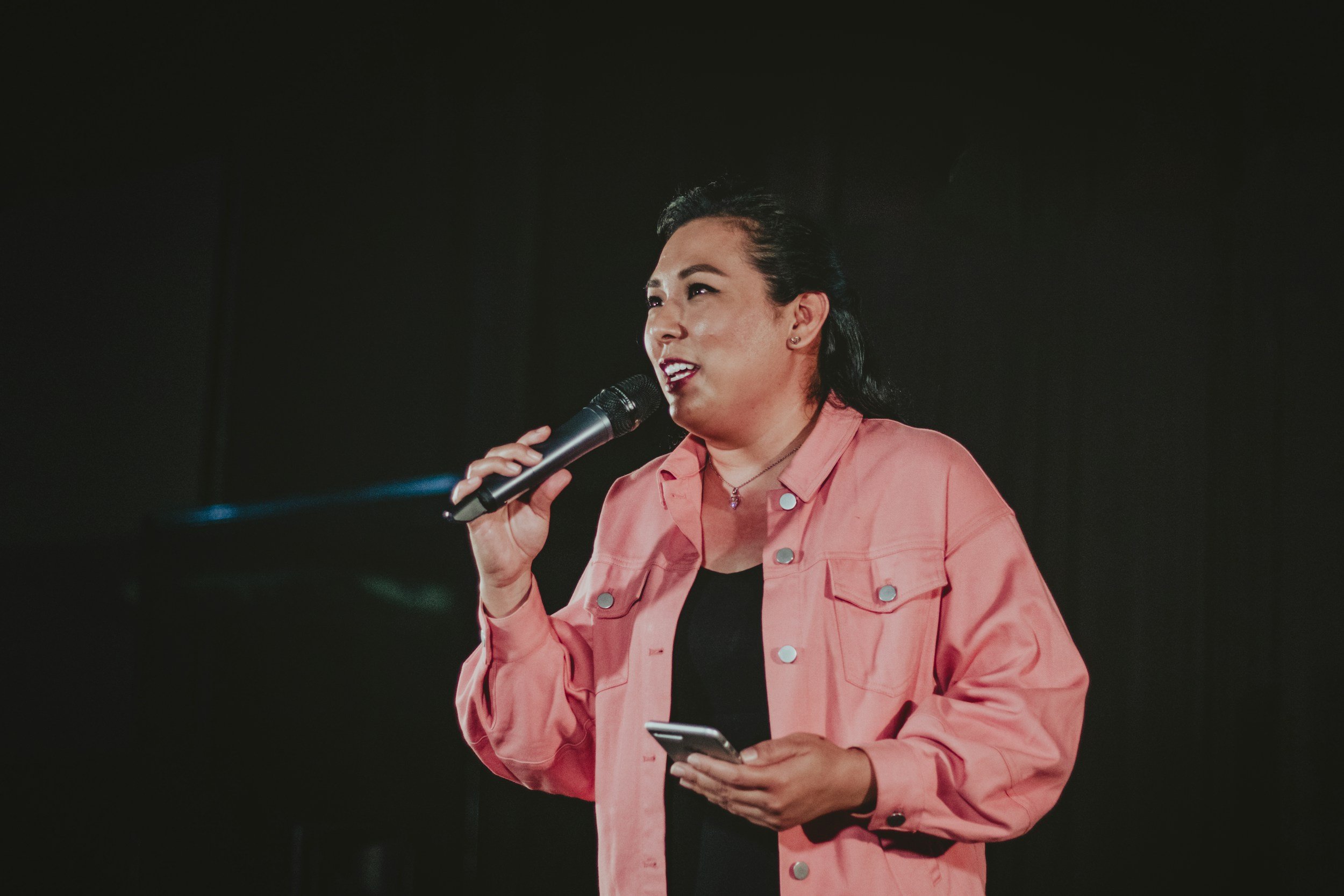
A photo from "Get HERd+ in Comedy!" TLC’s first time in the New York Comedy Festival Panel at The Stand. Panelists include Robby Hoffman (Showtime, The Chris Gethard Show), Jes Tom (Netflix, Hulu, HBOMax), Brittany Carney (Comedy Cellar Regular, That Damn Michael Che) and Sydnee Washington (Emmy Nominated Actress, How to Start a Fire).
A work-in-progress list of open mics vetted by the Collective as well as:
TLC Tips for Open Mic-ing
Indie Shows Guide
List of Specialty Mics + Shows
If you notice any missing information or have suggestions, I work best collectively.
Accessibility is an additional barrier I hope address better in 2026, with collective assistance.
Thank you for your collaboration and feedback as TLC works toward being the most inclusive comedy landscape for all.
OPEN MIC & SHOW RESOURCE GUIDE
Evermore Grief Support Centers
Hours vary; find out more at www.evermore.org/grief-support-directory -- Evermore’s directory lists support centers and other resources for grief by state.Open Path Psychotherapy Collective
Hours vary; find out more at https://openpathcollective.org/ -- You know we love a Collective! OPPC is a nonprofit nationwide network of mental health professionals, providing in-office and online mental health care—at a steeply reduced rate.Crisis Text Line – Text 741 741
Hours are 24/7; find out more details at www.crisistextline.org -- CTL lets you connect with a crisis counselor via text, chat, or WhatsApp.Suicide and Crisis Lifeline – Dial 988
Hours are 24/7; find out more details at www.suicidepreventionlifeline.org -- 988 provides confidential support from a crisis counselor for people feeling depressed, lonely, going through a tough time, or thinking about suicide via text, chat, and phone.The Trevor Lifeline (U.S. only):
Dial 1-866-4-U-TREVOR (488-7386) -- Hours are 24/7; find out more details at www.thetrevorproject.org/get-help -- The Trevor Project provides support for young members of the LGBTQ community via text, chat, and phone.Trans Lifeline
If you’re in the US, dial 877-565-8860; If you’re in Canada, dial 877-330-6366 -- Hours are Monday through Friday, 1:00pm – 9:00pm EST; find out more details at www.translifeline.org/hotline -- Provides anonymous, confidential peer support for trans & questioning people. Laughing Through Loss Resources